
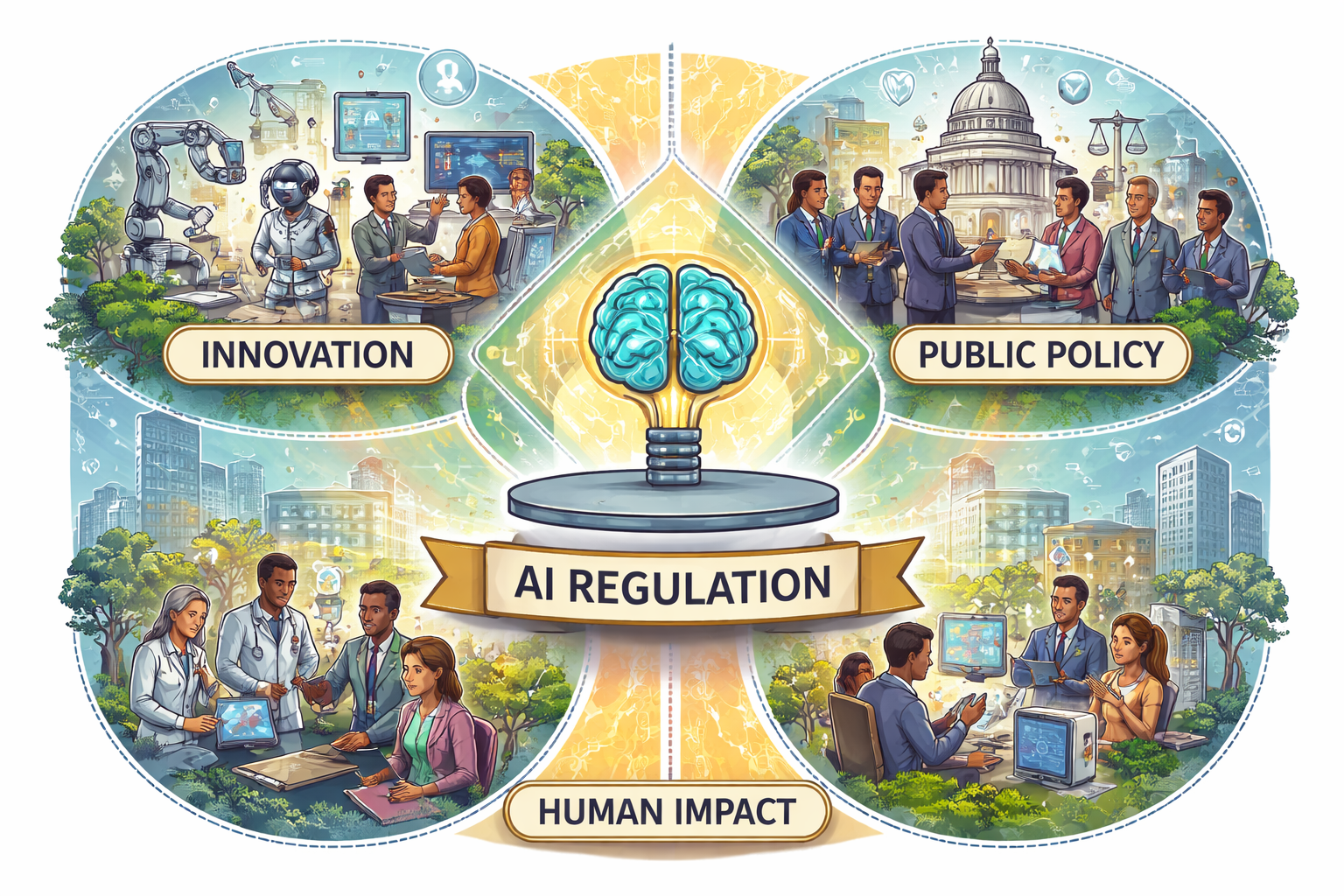
Hello, the artificial intelligence is faster than ever before. We are trying to follow these fast pacing environment in Inkpilots. In this article, we are going to examine the ai regulation and depict a possible future canvas.
Artificial intelligence is moving quickly from research labs into everyday life. It helps write emails, recommend videos, screen job applications, detect fraud, support medical workflows, and power customer service tools. As AI becomes more powerful and more widely used, governments and regulators are asking an important question: how do we encourage innovation while also protecting people from harm?
That is where AI regulation comes in. In simple terms, AI regulation is the set of laws, rules, standards, and enforcement mechanisms designed to shape how AI systems are built, deployed, and monitored. For beginners, the topic can feel technical or political, but the core ideas are surprisingly practical. AI regulation is really about accountability, safety, fairness, transparency, privacy, and trust.
This guide explains the basics of AI regulation in clear language. You will learn what AI regulation means, why it matters, what issues regulators focus on, how different countries are approaching it, and what it means for businesses and ordinary users.
What Is AI Regulation?
AI regulation refers to the legal and policy framework that governs artificial intelligence systems. It can include national laws, regional rules, government guidance, industry standards, and internal company policies. Not every rule is specific to AI. In many cases, existing laws on privacy, consumer protection, discrimination, product safety, intellectual property, and liability already apply to AI systems.
New AI-specific rules are emerging because some AI systems create risks that are hard to address with older laws alone. For example, an AI tool may make decisions that affect who gets hired, who receives a loan, or how a student is evaluated. In those cases, regulators want clarity on questions such as who is responsible, how decisions can be explained, what data was used, and what happens if the system causes harm.
A simple way to think about AI regulation is this: it sets boundaries for acceptable AI behavior and responsibilities for the people and organizations that create or use these systems.
Why AI Regulation Matters
AI can create real benefits, but it can also create real risks. Regulation exists because AI is not just a technical tool. It can influence rights, opportunities, safety, and public trust. If an AI system is inaccurate, biased, insecure, or used without proper oversight, the consequences can affect individuals and entire communities.
- Protecting people from harmful or unsafe AI outcomes.
- Reducing bias and discrimination in automated decisions.
- Safeguarding privacy and limiting misuse of personal data.
- Improving transparency so users understand when AI is being used.
- Clarifying accountability when systems fail or cause damage.
- Building trust so beneficial AI can be adopted more responsibly.
For businesses, regulation can also provide useful structure. Clear rules help organizations understand what is expected of them. That can reduce uncertainty, improve governance, and make it easier to design products that are acceptable in regulated markets.
The Core Issues Regulators Focus On
Although laws differ across countries, most AI regulation debates revolve around a common set of concerns. Understanding these themes makes the whole topic much easier to follow.
1. Fairness and Bias
AI systems learn from data, and data can reflect historical inequalities or flawed assumptions. If not carefully designed and tested, an AI model may treat some groups less favorably than others. Regulators are concerned about unfair outcomes in areas such as hiring, lending, housing, education, insurance, and law enforcement.
2. Transparency and Explainability
People often want to know when AI is being used and how it reached an outcome. Full technical explanations are not always possible or useful, but regulators increasingly expect meaningful transparency. That may include telling users they are interacting with AI, documenting how a system works, or explaining the main factors behind important decisions.
3. Privacy and Data Protection
Many AI systems depend on large amounts of data. Regulators pay close attention to whether personal information was collected lawfully, whether it is used for appropriate purposes, how long it is retained, and how securely it is protected. Training AI on sensitive or personal data raises especially important legal and ethical questions.
4. Safety and Reliability
An AI system that works well in one setting may fail in another. Regulators are increasingly focused on testing, monitoring, and risk management, especially when AI is used in high-impact areas. Safety is not just about physical harm. It can also include financial harm, emotional harm, reputational damage, or denial of access to essential services.
5. Accountability and Human Oversight
One of the biggest regulatory questions is who is responsible when AI makes or supports a decision. Developers, deployers, vendors, and users may all play a role. Many governance frameworks emphasize that humans should remain accountable for important decisions, even when AI tools are involved.
6. Security and Misuse
AI systems can be attacked, manipulated, or repurposed for harmful uses. Regulators and policymakers are increasingly concerned about cybersecurity, model abuse, identity fraud, deepfakes, and other malicious applications. This makes security controls and incident response planning an important part of AI governance.
How AI Is Regulated in Practice
AI regulation does not usually come from a single law with one universal rulebook. Instead, it often appears through several layers working together.
- Existing laws: privacy, discrimination, consumer protection, copyright, product liability, and sector-specific rules may already apply.
- AI-specific legislation: some governments are creating dedicated frameworks for high-risk or general-purpose AI systems.
- Regulatory guidance: agencies may publish expectations, interpretations, or best practices without passing a new law.
- Technical standards: standards bodies and industry frameworks can shape how compliance is measured in practice.
- Company governance: internal policies, review boards, documentation processes, and auditing procedures often fill operational gaps.
This layered approach means organizations cannot assume that if there is no single AI law, there are no rules. In many places, regulators are applying existing legal principles to AI right now.
Different Global Approaches to AI Regulation
Countries and regions do not regulate AI in exactly the same way. Some focus on broad rights-based frameworks, some rely more heavily on existing sector laws, and others emphasize voluntary guidance or national strategy. Even so, many approaches share common goals: reducing risk, preserving trust, and supporting responsible innovation.
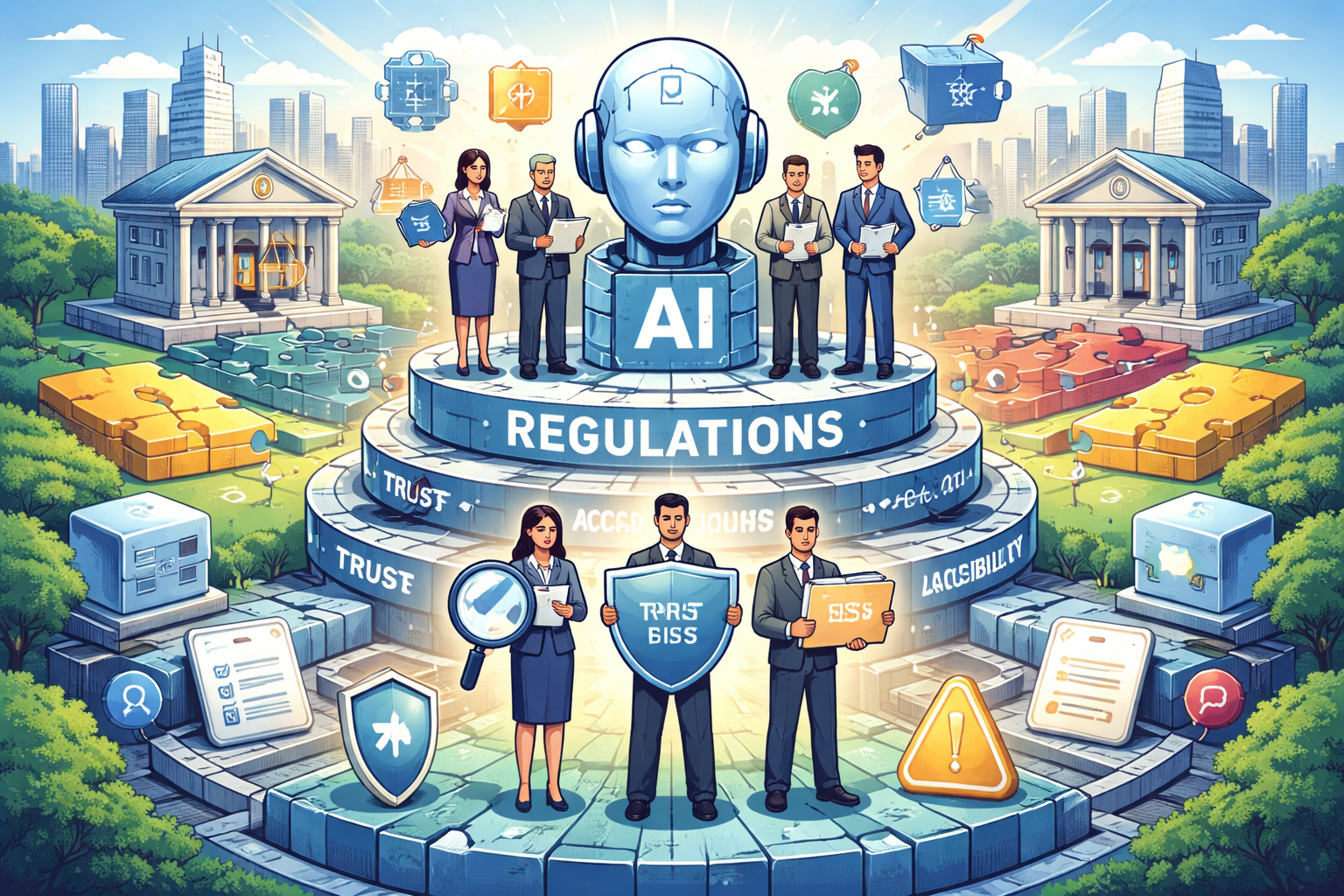
A common pattern is risk-based regulation. Under this model, the strictness of the rules depends on how much harm an AI system could cause. A low-risk AI tool, such as a recommendation feature for entertainment content, may face lighter obligations than an AI system used in hiring, policing, healthcare, or critical infrastructure.
"The higher the potential impact on people’s rights, safety, or opportunities, the greater the regulatory scrutiny tends to be."
— A simple way to understand risk-based AI regulation.
What Counts as High-Risk AI?
The exact definition varies, but high-risk AI generally refers to systems that can significantly affect a person’s rights, safety, livelihood, or access to essential services. These systems typically face stronger requirements for documentation, testing, oversight, and monitoring.
- Hiring and employee evaluation systems.
- Credit scoring or loan decision tools.
- Medical diagnostic or treatment-support systems.
- Educational admissions or assessment tools.
- Biometric identification systems in sensitive settings.
- AI used in policing, border control, or critical infrastructure.
In these contexts, regulators are more likely to expect human review, strong data governance, clear documentation, audit trails, and evidence that risks were assessed before deployment.
How Generative AI Fits Into the Picture
Generative AI adds new regulatory questions because it can produce text, images, audio, video, and code at scale. This creates concerns about misinformation, impersonation, copyright, unsafe content, and overreliance on machine-generated outputs. It also raises questions about how foundation models are trained and how providers should communicate limitations to users.
For beginners, the key point is that generative AI is not regulated only because it is novel. It draws attention because it can be deployed widely, influence public information, and produce outputs that are persuasive even when they are wrong. As a result, policymakers often focus on disclosure, content safeguards, model testing, and downstream accountability.
What AI Regulation Means for Businesses
For companies, AI regulation is not just a legal issue. It is also an operational and strategic issue. Organizations that build or use AI increasingly need processes for risk assessment, vendor review, recordkeeping, testing, governance, and employee training.
- Know where AI is being used across the organization.
- Classify systems by risk and business impact.
- Review the quality and legality of training and input data.
- Test systems for accuracy, bias, reliability, and security.
- Document intended use, limits, and oversight procedures.
- Assign clear ownership for approval, monitoring, and incident response.
- Update contracts with vendors that provide AI tools or models.
Businesses that start early are often better positioned than those that treat AI governance as a last-minute compliance exercise. Good governance can improve product quality and reduce reputational, legal, and operational risk.
What Everyday Users Should Know
You do not need to be a lawyer or engineer to understand the practical side of AI regulation. As an everyday user, it helps to know when AI is being used, what kind of data you are sharing, and whether an important decision is being made entirely by software or with human review.
- Ask whether a decision was made or supported by AI.
- Look for privacy notices and terms about data use.
- Be cautious with sensitive personal information.
- Do not assume AI outputs are always accurate.
- Request human review when a decision has serious consequences.
- Watch for manipulated or synthetic media presented as real.
Regulation can strengthen these protections, but informed users still play an important role. Healthy skepticism and basic digital literacy remain essential.
Why AI Regulation Is So Challenging
Regulating AI is difficult because the technology changes quickly, works differently across use cases, and crosses national borders. A rule that makes sense for one type of AI may be too weak or too strict for another. Regulators also need to balance several goals at once: protecting the public, supporting innovation, encouraging competition, and avoiding rules that become outdated immediately.
Another challenge is that AI systems are not always easy to inspect from the outside. Their performance can shift over time, depend on context, or vary across groups. That means effective regulation often requires ongoing monitoring rather than a one-time approval.
What the Future May Look Like
AI regulation is likely to become more detailed, more sector-specific, and more international over time. We can expect continued debate over how to regulate powerful general-purpose models, how to address synthetic media and identity risks, and how to coordinate rules across borders.
At the same time, one idea is likely to remain central: not all AI should be treated the same. The future of regulation will probably continue to focus on proportionality, meaning stronger obligations where the potential for harm is higher and lighter-touch rules where the risks are lower.
Conclusion
AI regulation can sound complicated, but its basic purpose is straightforward. It aims to make sure AI is used in ways that are safe, fair, transparent, and accountable. For beginners, the most important takeaway is that AI regulation is not about stopping innovation. It is about setting rules so innovation can happen responsibly.
As AI becomes more embedded in daily life, understanding regulation will become increasingly useful for business leaders, employees, students, and consumers alike. The more people understand the rules being proposed and why they exist, the better prepared society will be to shape AI in the public interest.
Does this bother our application much ? Actually, it does. There are drawbacks but generally, we assume user data will be publicly shared.
This is all for now, thank you for reading. For more follow our blog page.