

Tracking Brand Voice Consistency via Inkpilots
Brand voice is one of the few marketing assets that compounds over time. When every article, landing page, email, and product update sounds like it comes from the same organization, audiences build recognition faster and trust more easily. The challenge is that consistency becomes harder as teams grow, channels multiply, and more contributors participate in content creation. That is where a structured workflow around Inkpilots can help.
Tracking brand voice consistency via Inkpilots is not only about catching off-brand wording. It is about building a repeatable editorial system: defining what the brand should sound like, checking whether content matches that standard, and turning each review into guidance the team can reuse. With the right process, consistency stops being subjective and becomes operational.
Why brand voice consistency matters
A consistent voice helps readers know what to expect from your company. It reduces friction across the customer journey because the tone on a blog post aligns with the tone in onboarding emails, support articles, and sales materials. Internally, consistency also improves efficiency. Writers spend less time guessing how to phrase a message, editors make decisions faster, and stakeholders review content against shared standards instead of personal preference.
Inconsistent voice creates the opposite effect. One team may sound formal and cautious, while another sounds casual and promotional. Even when the underlying information is accurate, the overall experience can feel fragmented. Over time, that weakens brand memory and makes it harder for content to communicate a clear identity.
What tracking looks like in practice
Effective tracking starts with a clear voice framework. Before using Inkpilots to review content, teams need a documented standard that explains the brand’s tone, vocabulary, level of formality, preferred sentence style, and messaging boundaries. For example, a brand may want to sound confident but not aggressive, expert but not academic, and approachable without becoming overly casual. Without that foundation, consistency reviews become unclear and difficult to scale.
Once the framework exists, Inkpilots can support a more disciplined review cycle. Teams can assess content against a fixed set of criteria such as tone alignment, terminology usage, audience fit, structural clarity, and message cohesion. Instead of asking whether a piece ‘sounds right,’ reviewers can ask more precise questions: Does this opening match the brand’s level of warmth? Are claims stated in the preferred level of confidence? Does the call to action sound helpful or overly forceful? Precision makes feedback more useful.
How Inkpilots Provides Consistency
- First you must create an unpublished article and write your guidelines inside. You can add instructions to how agent to write and follow to be consistent between session. Ensure you do not publish the article, since guideline will be internal and private to your agents.
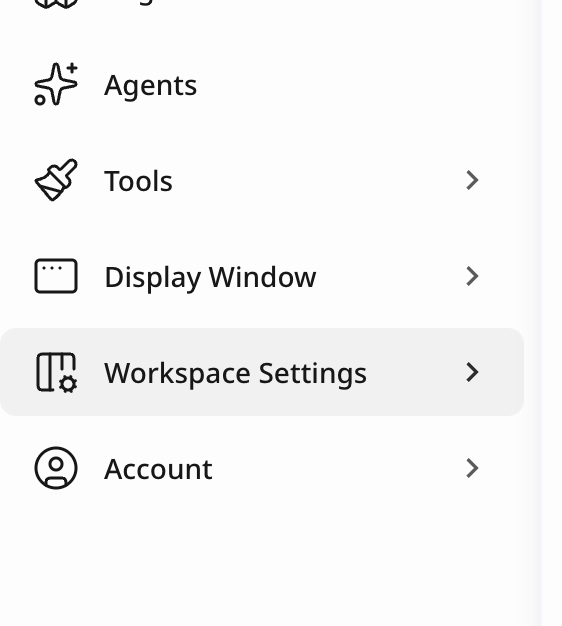
- Click to Workspace Settings from sidebar.
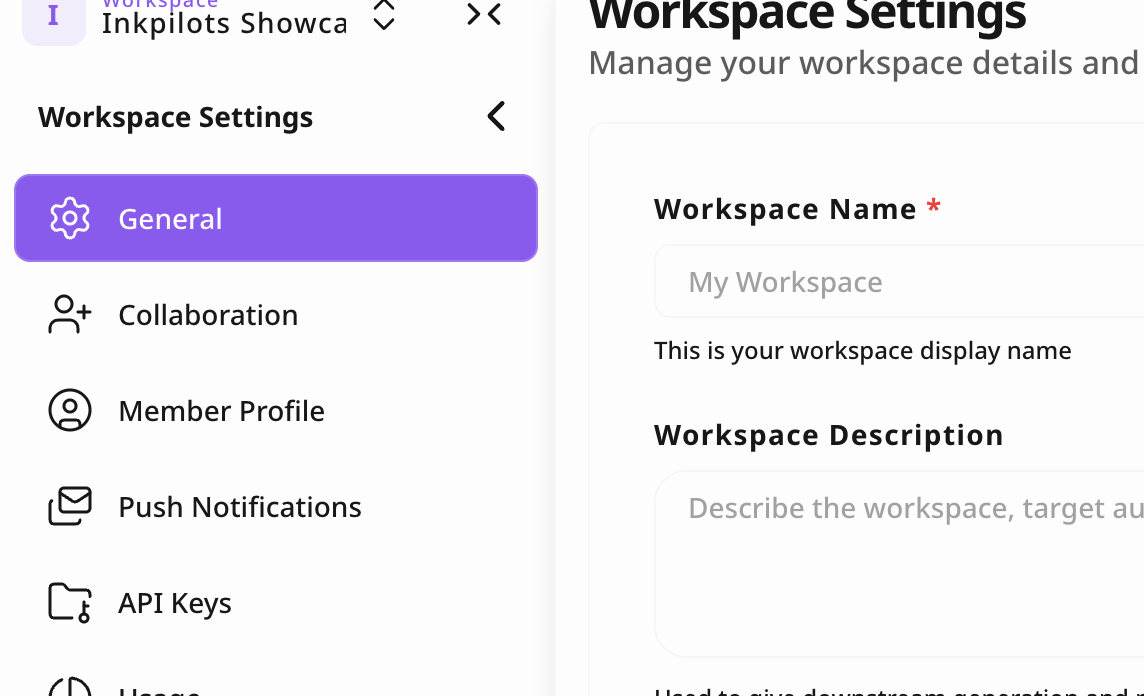
- Select General from sidebar
- Scroll to bottom. You must see the Brand Voice Guideline input field. Type article name and select it. Do not forget to save!
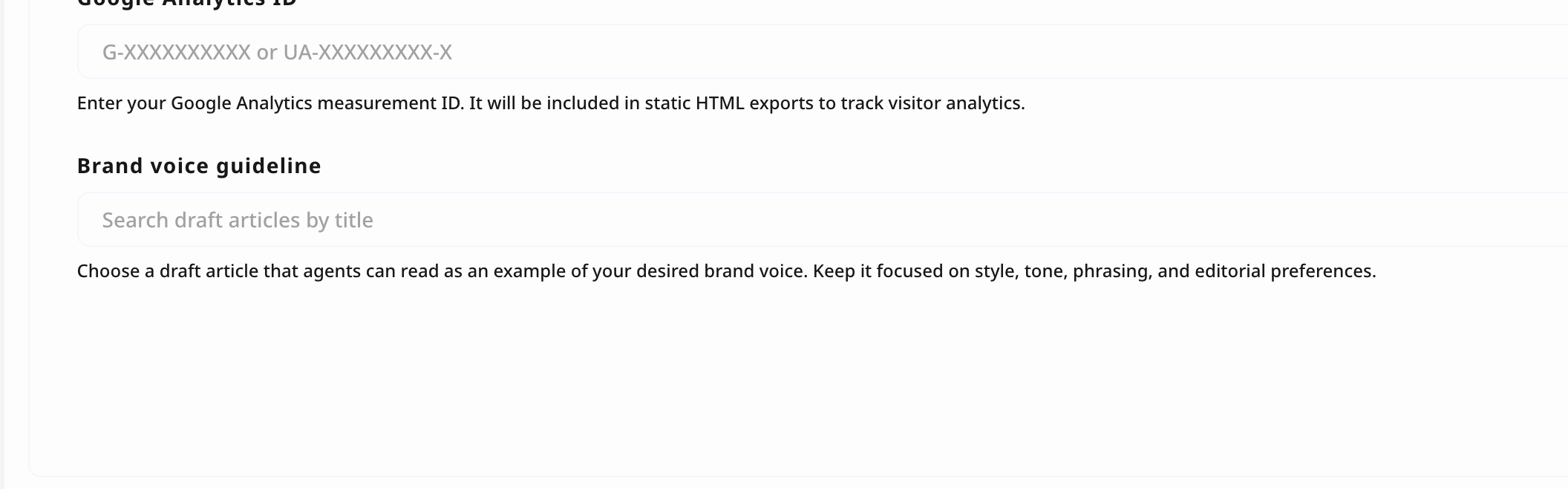
If you have done these steps properly, your agents will read you guideline to follow your instructions properly.
Core signals to monitor in Inkpilots
- Tone stability across sections: Check whether the article begins, develops, and concludes in a consistent manner rather than shifting between styles.
- Terminology consistency: Use the same names for products, services, customer groups, and internal concepts across drafts and channels.
- Sentence rhythm and readability: Monitor whether writing patterns support the brand personality, whether concise and direct or more thoughtful and explanatory.
- Claim framing: Ensure benefits, promises, and positioning statements reflect the brand’s preferred level of confidence and restraint.
- Call-to-action language: Review whether next-step language sounds aligned with the brand rather than generic or overly sales-driven.
These signals matter because brand voice is rarely broken by one obvious sentence. More often, inconsistency appears through accumulation: a slightly different phrase here, a sharper sales tone there, and a technical paragraph that feels disconnected from the rest. Tracking repeated patterns through Inkpilots helps teams identify drift before it becomes normalized.
Building a review workflow that scales
To make tracking sustainable, teams should define a lightweight governance model. Start by assigning ownership for the voice standard, usually within content, brand, or editorial operations. Then create a review sequence for high-impact assets. Not every piece of content needs the same level of scrutiny, but cornerstone pages, thought leadership articles, campaign assets, and executive communications usually deserve stricter review.
A practical workflow inside Inkpilots often follows five steps. First, the writer drafts against the brand voice guide. Second, the draft is reviewed for clarity and strategic alignment. Third, voice-specific issues are flagged and categorized. Fourth, the writer revises using that feedback. Fifth, recurring issues are added back into the team’s guidance so future drafts improve faster. This loop transforms review from one-off correction into continuous editorial training.
How to reduce subjectivity
One of the biggest obstacles in brand voice management is subjective feedback. Comments like ‘make this stronger’ or ‘this doesn’t feel like us’ are hard to action because they lack a reference point. Inkpilots becomes more valuable when teams pair it with explicit scoring rubrics or review labels. For instance, reviewers can mark issues as formality mismatch, unsupported emphasis, jargon overload, or inconsistent audience address. That structure makes feedback clearer and easier to compare across drafts.

Metrics that actually help
Brand voice consistency is difficult to improve if it is discussed only in qualitative terms. Teams should track a few simple operational metrics around their Inkpilots workflow. Useful examples include the number of voice-related revisions per asset, the most common categories of feedback, the percentage of drafts approved without major tone changes, and the recurrence rate of the same issue across multiple writers or teams. These measures do not replace editorial judgment, but they make patterns visible.
The goal is not to force creativity into a rigid template. It is to understand where inconsistency appears most often and whether the team is improving over time. Strong brands usually balance discipline with flexibility: the voice stays recognizable, while the expression adapts to audience needs and content format.
We are hoping to build a suggestions and workflow sections. This way you will get consistent suggestions and create review workflows for your text generation.
Common mistakes to avoid
- Treating voice as a vague concept instead of documenting it in practical editorial language.
- Reviewing only for grammar and factual accuracy while ignoring tone, framing, and audience fit.
- Applying one identical tone to every channel without allowing for context-sensitive variation.
- Giving writers corrective feedback without updating shared guidance.
- Relying on isolated reviewer preferences instead of agreed standards and examples.
A smarter way to protect brand identity
Tracking brand voice consistency via Inkpilots works best when it is approached as an operating system for content quality. The technology or platform can support the process, but the real value comes from disciplined standards, repeatable reviews, and feedback loops that help people write better over time. When those pieces are in place, consistency is no longer a bottleneck. It becomes a competitive advantage.
For organizations producing content at scale, that advantage is substantial. A recognizable voice sharpens positioning, improves reader experience, and gives every published asset a stronger connection to the brand behind it. Inkpilots can play an important role in that system by turning brand voice from a creative aspiration into a trackable editorial practice.
For more features and how-tos check out our blog. We use blog page as testing area.
To start using using Inkpilots, check out the link. Thank you for reading.